Sugarcane was introduced to the Caribbean by Christopher Columbus in 1493. Since then, the sugar industry flourished and sugar has become a major factor in the growth of the food industry. This has resulted in the overconsumption of added sugars in the American diet.
Carbohydrates
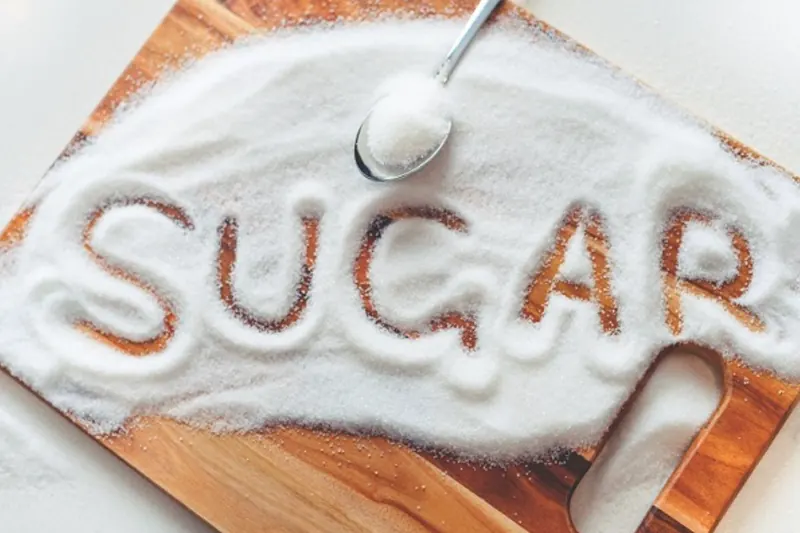
Carbohydrates (CHO’s) are an essential nutrient to human life. There are two categories of CHO’s; complex and simple. Complex CHO’s actually contain carbohydrate plus fiber. Most of our CHO consumption should be from complex CHO’s. Simple CHO’s contain no fiber and are responsible for the sweet taste in many foods. Sugar is a simple CHO and has 4 “empty” calories per teaspoon, which means it contains no nutritional value. Due to its negligible nutritional content, simple sugar should be limited in the diet.
Daily Intake of Sugar
The suggested daily limit of simple sugars based on a 2,000-calorie diet would be 5% or 25 grams. The recommended daily sugar limit is 6 tsp. (25 g) for women, and 9 tsp. (38 g) for men; however, the average American consumes approximately 19.5 teaspoons (82 grams) every day which translates into about 66 pounds of added sugar consumed each year, per person. Excessive sugar intake is stored as fat and can lead to obesity, which is a huge risk factor for developing type 2 diabetes.
Insulin
Insulin plays a major role in the way the body uses digested food for energy. When the digestive tract breaks down carbohydrates into its simplest form, glucose, it is absorb into the bloodstream and insulin helps cells absorb glucose to use for energy. In a healthy person, these functions allow blood glucose and insulin levels to remain in the normal range.
In individuals with insulin resistance, cells do not respond properly to insulin and cannot easily absorb glucose from the bloodstream. As a result, the body needs higher levels of insulin to help glucose enter cells. Over time, the stress on the body from the over secretion of insulin can increase the risk of developing prediabetes and type 2 diabetes. Studies show that weight management, regular physical activity, and making healthier food choices such as consuming foods lower in glycemic index can prevent or slow the progression of chronic disease. The following video explains insulin resistance in detail: nutritionfacts.org/video/what-causes-insulin-resistance/
Glycemic Index
The Glycemic Index (GI) is a relative ranking of carbohydrate in foods according to how they affect blood glucose levels. Foods are assigned a score based on how much they raise blood sugar levels, from 0-100. Glucose, a pure simple sugar, has a glycemic index of 100 and is considered the reference food. Low glycemic foods do not raise blood sugar levels as much as high glycemic foods.
Low GI= < 55 Medium GI= 56 – 69 High GI= >70
Consuming low GI foods may help to facilitate the management of diabetes, weight loss, and weight loss management, and reduce the risk of developing type 2 diabetes. It also may help to reduce complication of diabetes, and possibly delay and/or prevent other chronic diseases, like CKD. In fact a low GI diet may provide health benefits for everybody across all stages of life.
Natural Sugars and Alternatives
Find a comprehensive listing and explanation of several sugars, alternative sugars, natural sweeteners, and artificial sweeteners by clicking HERE.
Also, the graph below compares the glycemic index between some sugars, natural sweeteners, artificial sweeteners and sugar alcohols:
Low GI= < 55 Medium GI= 56 – 69 High GI= >70
References
- ncbi.nlm.nih.gov/pmc/articles/PMC2836749/
- ncbi.nlm.nih.gov/pubmed/24007486
- niddk.nih.gov/health-information/diabetes/overview/what-is-diabetes/pr
- sugarscience.ucsf.edu/the-growing-concern-of-overconsumption/#.WgxnddK
- “Portion Control.” American Diabetes Association. diabetes.org/for-parents-and-kids/diabetes-care/portion-control.jsp
- fda.gov/AboutFDA/Transparency/Basics/ucm194320.htm
- glycemicindex.com/foodSearch.php
- Jenkins, D. J.,Wolever, T. M.,Taylor, R. H.,Barker, H.,Fielden, H.,Baldwin, J. M.,Bowling, A. C.,Newman, H. C.,Jenkins, A. L., andGoff, D. V. ( 1981) Glycemic index of foods: a physiological basis for carbohydrate exchange. Am. J. Clin. Nutr. 34, 362–366.
- Ludwig, D. S. ( 2002) The glycemic index: physiological mechanisms relating to obesity, diabetes, and cardiovascular disease. JAMA 287, 2414–2423.
- Goyal, S.K., Samsher and Goyal, R.K. (2010). Stevia (Stevia rebaudiana) a bio-sweetener: A review. International Journal of Food Sciences and Nutrition, 61, 1, 1-10. Kobylewski, S. and Eckhert, C.D. (2008). Toxicology of rabaudioside A: A review. Retrieved July 20, 2011. cspinet.org/new/pdf/stevia-report_final-8-14-08.pdf
- Bogdanov S, Jurendi T, Siebe R, Gallman P. Honey for nutrition and health: a review. J. Am. Coll. Nutr.27,677–689 (2008). Crossref, Medline, CAS futuremedicine.com/servlet/linkout?suffix=ref-3&dbid=16&doi=10.2217%2F
- mayoclinic.org/healthy-lifestyle/nutrition-and-healthy-eating/in-depth
- “How Sugar Affects Diabetes.” WebMD. diabetes.webmd.com/how-sugar-affects-diabetes
- nutritionfacts.org/video/what-causes-insulin-resistance/
- Michael Greger M.D. FACLM January 6th, 2017 Volume 33 nutritionfacts.org/author/mgreger/